
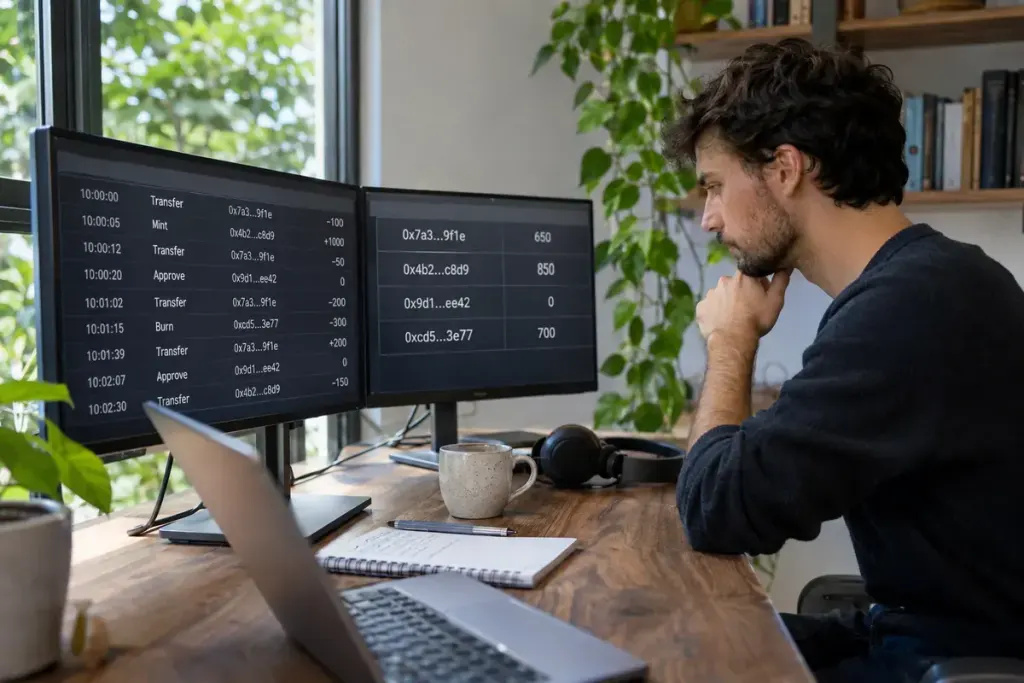
A block explorer shows an event announcing that an application action occurred. Does that mean the smart contract can later read the event as if it were a variable? In ordinary Solidity execution, the two mechanisms are different.
The Solidity documentation on events explains that events provide an interface to EVM logging. Logs can be observed through external infrastructure, but their data are not directly accessible from within contracts, including the contract that emitted them.
State and notification serve different readers
Imagine a simple application that records whether a membership is active. If future on-chain logic must check that status, the design needs an appropriate source of state that the contract can access. Emitting a “membership activated” event is useful for an external interface, but it does not automatically create a readable storage variable.
An off-chain service might watch the event and update a display. That service must still handle the realities of data retrieval and chain history, such as missed ranges or reorganisations. A notification seen once is not a complete persistence strategy for the application.
Special proof-based designs can establish facts about past logs, but they require additional mechanisms. They do not change the basic distinction between directly accessing storage and reading an event emitted earlier.
Ask who needs the information next
For each piece of data, identify whether a future contract call needs it, whether an external indexer needs it, or both. Then consider cost, access and correctness together. Choosing logs simply because they appear convenient can leave the next on-chain operation without the state it requires.
When reading a transaction, distinguish the contract’s state changes from the events it emitted. Both can be informative, but neither the event name nor an explorer’s friendly label should replace inspection of what the application actually does.