
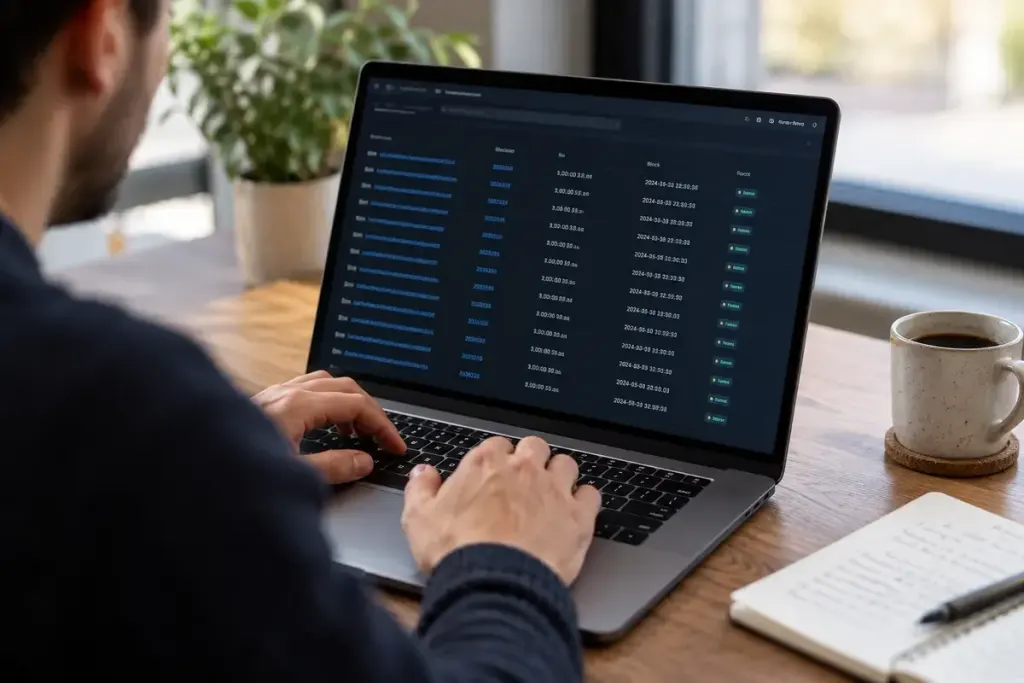
You submitted a transaction at one time, but the explorer shows another. Before assuming the record is wrong, check which event each clock describes and which time zone the interface displays.
Ethereum’s block documentation includes a timestamp among block data. A block timestamp is associated with the block containing transactions; it is not a personal stopwatch record of the moment you clicked a wallet button.
Separate submission from inclusion
A transaction can be created, signed, broadcast and included at different moments. A wallet’s activity screen may display one of those events, while an explorer shows the containing block’s time. The label matters more than the fact that both fields look like dates.
For an investigation, save the network, transaction hash, block number and displayed timestamp. Record whether the explorer labels the time as UTC, local time or an elapsed phrase such as “five minutes ago.” Relative wording changes as time passes.
Compare the same moment in the same zone
Convert timestamps to a common time zone before comparing records. Keep the original value as well so the conversion can be checked. A date can change when the same moment is displayed on opposite sides of midnight in different zones.
Do not infer the sender’s location from the time displayed by your browser. The interface may use your settings, and a blockchain record does not generally establish where a person was physically located.
Different networks define and validate time in different ways. Use the documentation for the chain you are examining rather than applying Ethereum terminology to every explorer.
If you need to explain a delay, distinguish the known interval from the cause. The record may show that inclusion happened later than submission without proving whether the reason was fees, congestion, wallet behaviour or another factor. A precise timeline is useful evidence; an unexplained gap is not permission to invent the explanation.